
Tel. +39 0471 797 897 info@funiviaortisei.eu ortiseialpedisiusi@pec.it
Group requests: groups@funiviaortisei.eu
Via Setil, 9 - 39046 Oltretorrente/Ortisei BZ
For correct display of the website content it is required to accept cookies.
THE CABLE CAR
Ortisei - Alpe di Siusi Cable Cars S.p.A. | REA: BZ 21182 | VAT number: 00407190214
Since 1935 the first cable car of the Alpe.
History of the plant
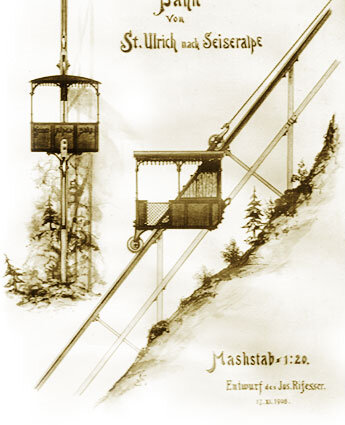
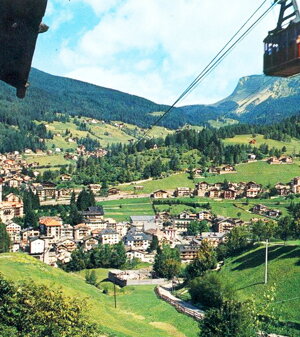
The founding of the Alpe di Siusi cable car was truly a pioneering achievement, given that the idea of a connection between Ortisei and the overlying Alpe (with an elevation difference of 800 meters) dates back to 1929; at that time, its realization seemed like a highly futuristic undertaking.
The first idea was a hybrid between a funicular railway and a cable car, with a vehicle that would travel on a suspended rail and be pulled by a cable.
The choice then shifted to a more classic double-cable cable car, similar to the systems built at the time in the Alps.
In 1935, for the first time, the two wooden cabins set off on the first run. The transport capacity of the system built by engineer Zuegg from Lana was only 16 people, but for the first time anyone from Ortisei could reach the Alpe in just a few minutes of travel. A real revolution.
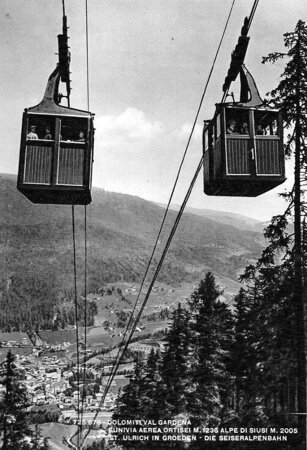
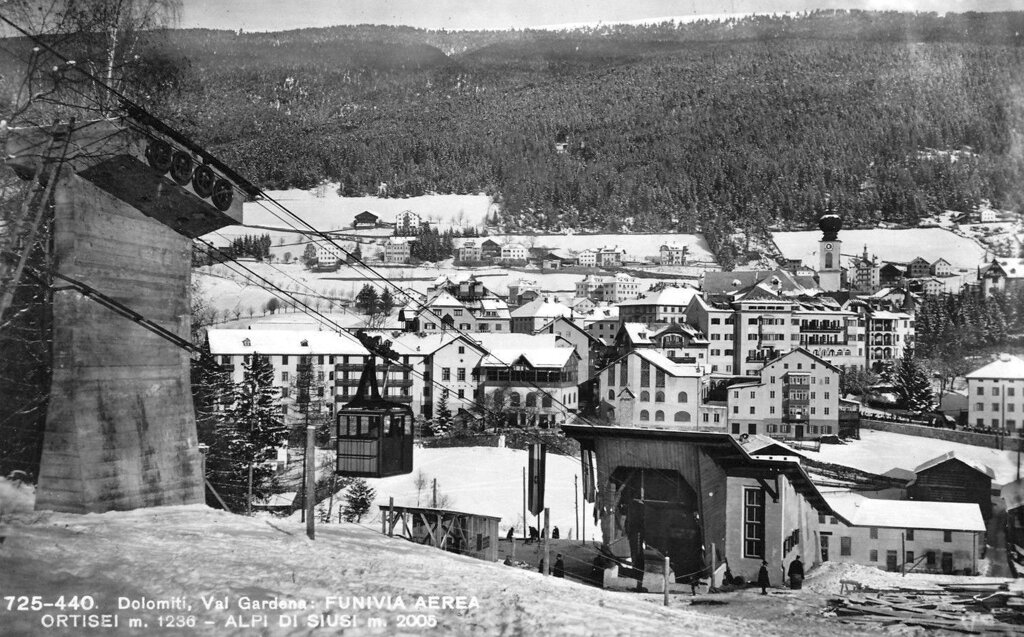
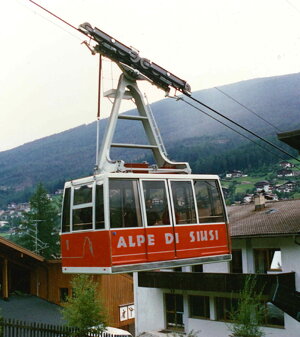
In 1955, the facility was modernized by the Hoelzl company, with an expansion of the valley station and new cabins, no longer made of wood (later covered in sheet metal), but entirely made of sheet metal.
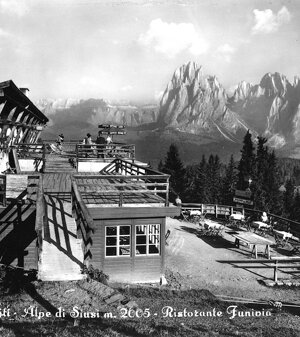
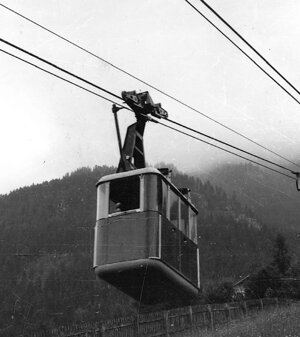
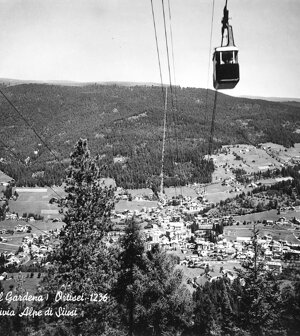
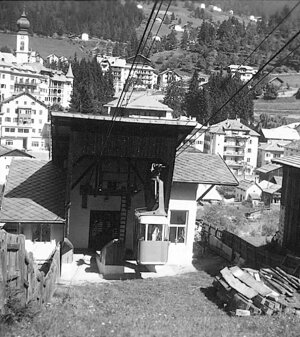
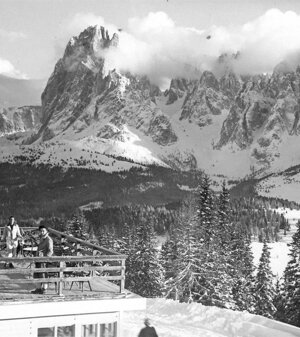
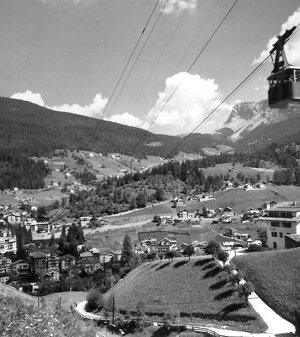
Winter tourism began to flourish in the following years and it became necessary to increase the capacity of the cable car to eliminate the long queues that formed at the base.
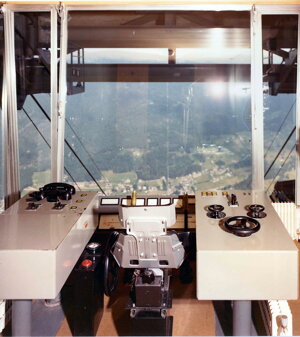
In 1968, the system was completely rebuilt by the Hoelzl company, on a parallel route, 1870 meters long and with a maximum capacity of 500 people per hour thanks to the larger cabins. A new modernization, in 1989, led to the replacement of the cabins and the electric control drive.
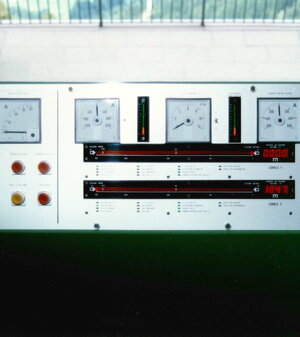
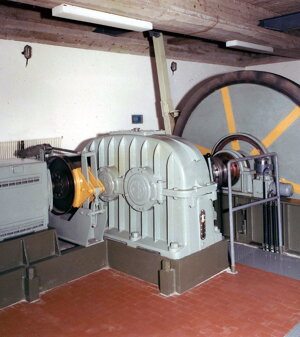
The bicable gondola lift
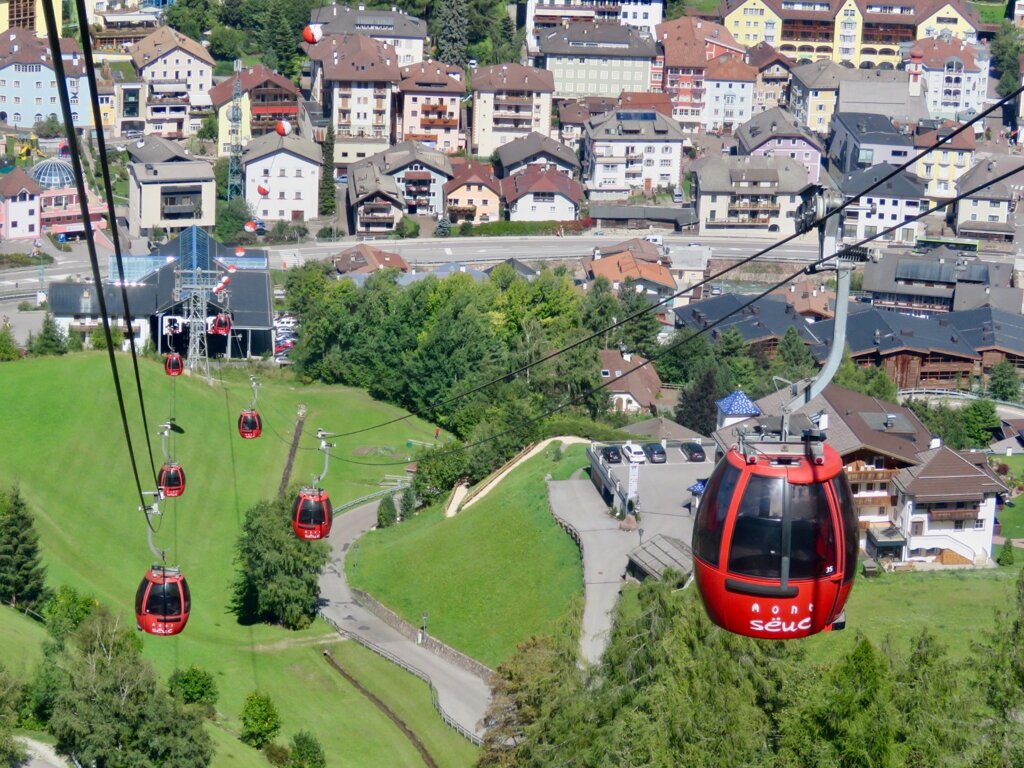
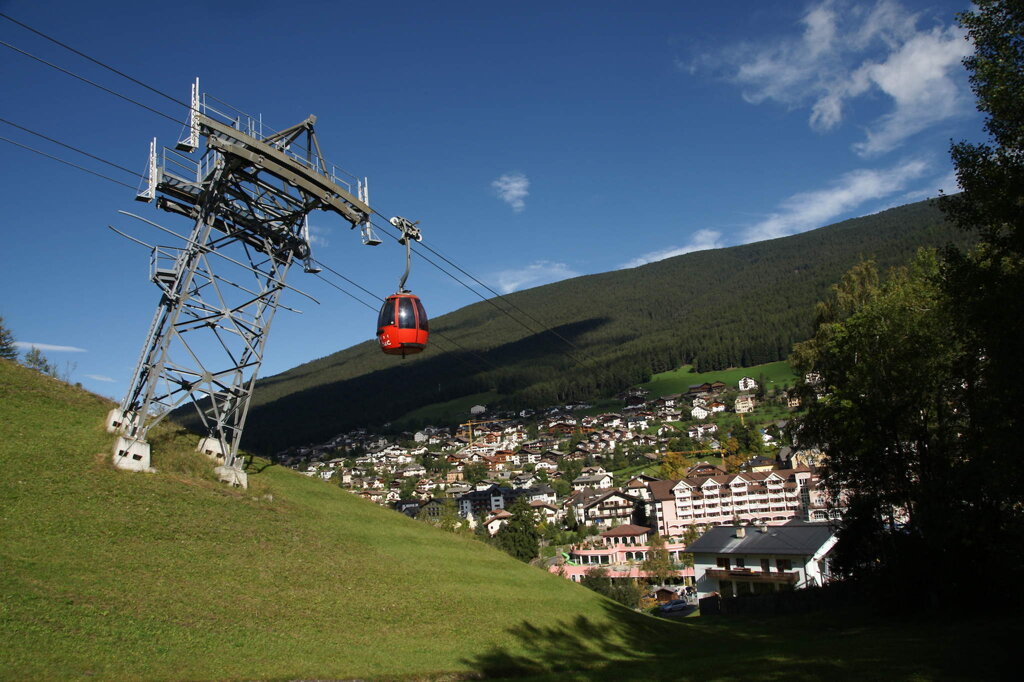
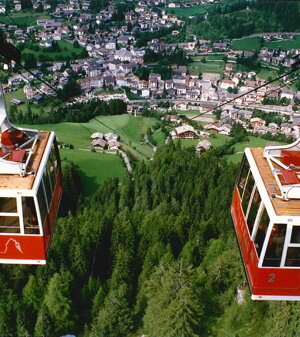
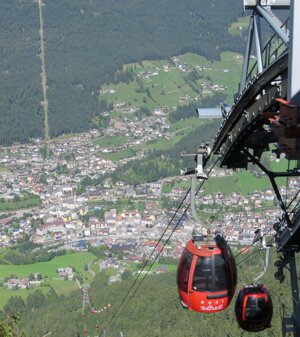
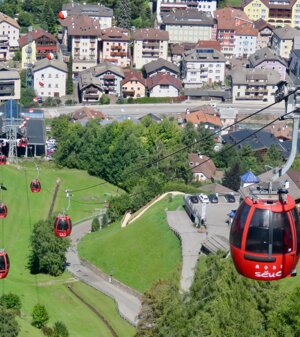
The current cable car, built by the company LEITNER from Vipiteno, was inaugurated at Christmas 1999, and with its 35 cabins for 15 people each, offers a transport capacity of 2,200 people per hour. The ascent lasts about 5 minutes in cabins with 9 seats and 6 standing places.
The system was completely modernized during the twenty-year overhaul in 2018.
Unlike the many systems present around the world, this cable car stands out for being a bicable system, which is rather rare nowadays.
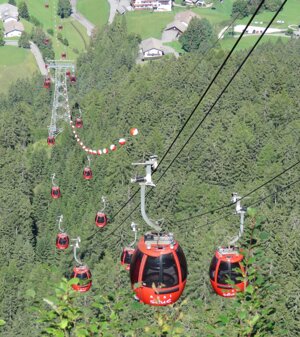
For each route, there is not just one carrying-hauling cable as in normal cable cars and chairlifts, but two distinct cables:
- A closed carrying cable (i.e., smooth in its section) anchored at both stations that supports the weight of the cabins
- A closed-loop hauling cable made of strands that pulls the cabins
This solution allows large spans to be crossed with few supports, as in our case, and guarantees greater stability in crosswinds compared to single-cable systems.
The cabins are equipped with 4-wheel bogies that run on the carrying cables and an automatic grip that closes on the hauling cable during the journey, releasing it in the stations, where the cabins are moved by conveyors consisting of rubber wheels driven by electric motors.
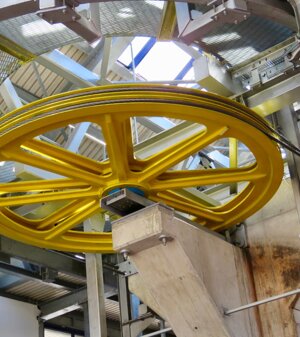
The drive winch is underground and located at the mountain station; at the valley station, there is a hydraulic cylinder, visible at the center of the station, which moves the tensioning pulley of the hauling cable. To reduce the length of the station, there are two return pulleys, to tension the cable towards the mountain instead of towards the valley.
The carrying cables are anchored at both stations, and there are no counterweights; they are supported by two pylons, 16 and 32 meters high respectively.
The safety and operation signals between the mountain and valley stations are transmitted via the hauling cable loop, with a carrier wave system that uses the cable itself as a conductor. There is also a guard cable, inside which optical fibers and copper conductors are integrated for lightning discharge, and which supports the aerial obstacle marker spheres.
In case of a power outage, there is a generator to guarantee energy autonomy for many hours. In case of failure of both main motors, there is a third hydraulic motor to bring the cabins back to the station at reduced speed. In the rare case that it is not possible to move the system, two rescue trolleys are stored on the mountain support, which can be lowered along the cables and, positioning themselves under the stopped cabins, allow passengers to descend and be brought back to the station.
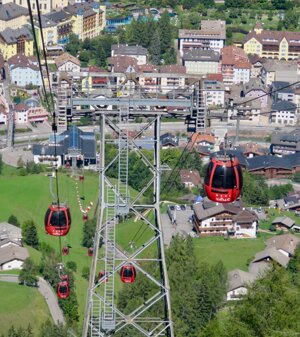
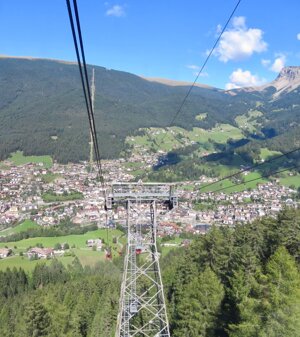
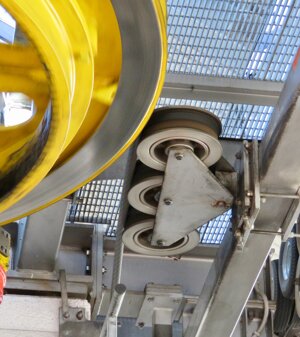

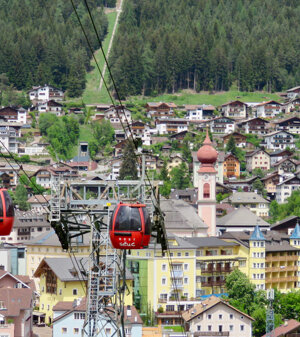
Travel on the cable car in 360° virtual reality
Rotate with the mouse or turn your smartphone for 360-degree navigation.

Tel. +39 0471 797 897 info@funiviaortisei.eu ortiseialpedisiusi@pec.it
Group requests: groups@funiviaortisei.eu
Via Setil, 9 - 39046 Oltretorrente/Ortisei BZ
For the correct display of the website content it is required to accept cookies.
Funivie Ortisei - Alpe di Siusi S.p.A. | REA: BZ 21182 | VAT number: 00407190214